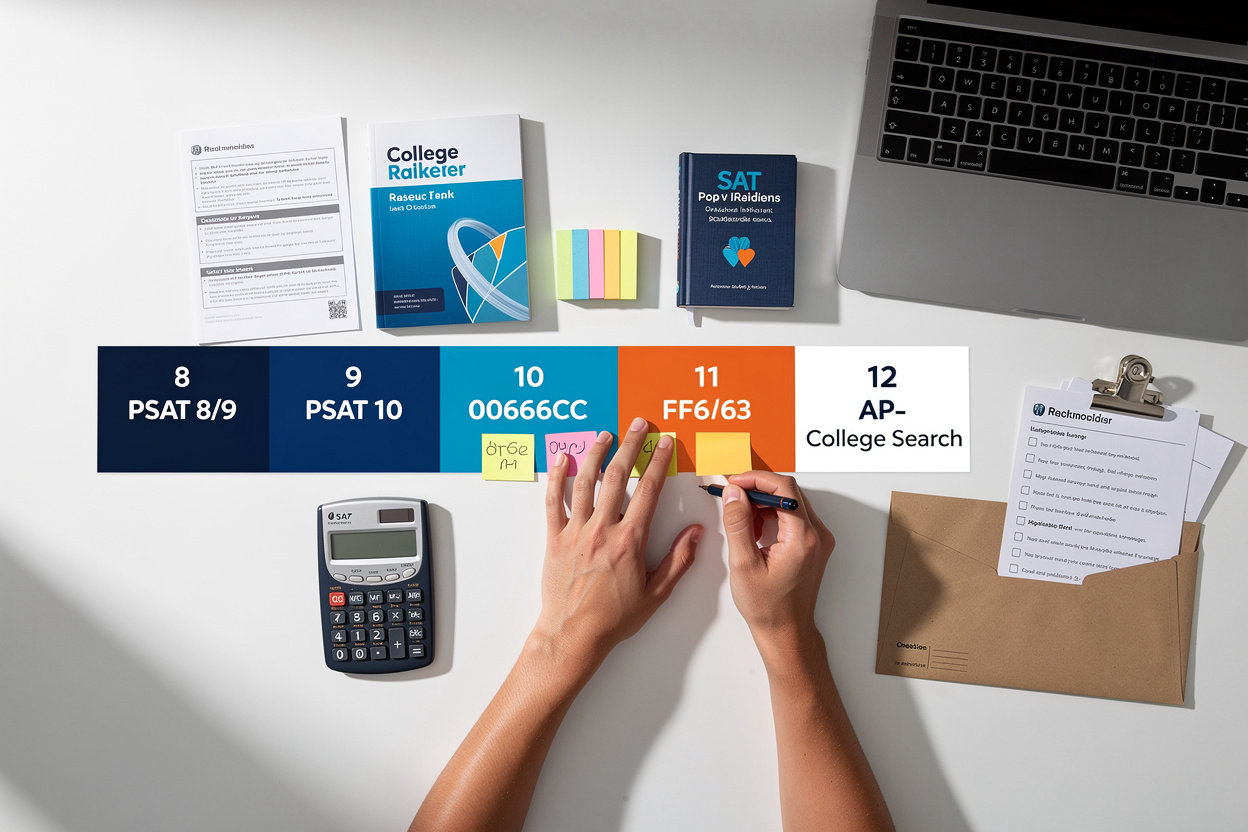
Your College Readiness Timeline
From 8th grade through senior year, we've mapped out the key milestones, testing windows, and college planning steps you need to know. No surprises—just clarity on what's coming and when.
Explore & Prepare
Take the PSAT 8/9 to build test-taking skills and understand what the SAT measures. This is your low-pressure introduction to standardized testing—no scores that affect college admissions, just valuable insights.
Testing Window
Fall (September–October)
Key Actions
Talk to your school counselor about PSAT 8/9 registration. Start thinking about your interests and potential majors.
Build Your Foundation
Take the PSAT 10 in spring. This score enters you into the National Merit Scholarship competition if you're a junior next year. Use your results to identify areas to focus on for SAT prep.
Testing Window
Spring (April–May)
Key Actions
Register for PSAT 10 through your school. Explore SAT prep options and Khan Academy's free Official SAT Practice. Consider AP classes for junior year.
SAT, AP, and College Search
This is your busiest year. Take the SAT (multiple testing windows available), complete AP exams if enrolled, and launch your college search using BigFuture. Start thinking about your college priorities: location, size, majors, cost.
Testing Windows
SAT: March, May, June, August, October, November, December | AP Exams: May
Key Actions
Register for SAT (registration deadlines are 3 weeks before test date). Begin SAT prep with Khan Academy. Start college search on BigFuture. Request information from colleges. Plan college visits for summer or fall.
Applications and Financial Aid
Focus on college applications and financial aid. Take the SAT again if you want to improve your score (test dates through December). Complete AP exams if enrolled. Complete CSS Profile and FAFSA for financial aid. Apply to colleges with your target deadlines.
Testing Windows & Deadlines
SAT: September, October, November, December | AP Exams: May | CSS Profile: Opens October 1 | College Application Deadlines: November–January (early/regular decision)
Key Actions
Complete CSS Profile and FAFSA (don't skip CSS Profile—many colleges require it for need-based aid). Submit college applications on schedule. Request SAT score reports be sent to colleges. Review financial aid packages carefully. Make your final college choice by May 1.
Ready to Get Started?
Use the resources below to take your next step on the college readiness timeline.
SAT & PSAT Preparation
Preparing for the SAT or PSAT doesn't have to be stressful. We've put together everything you need to feel confident and ready on test day—from free practice materials to proven test-taking strategies.
Official SAT Practice on Khan Academy
The best way to prepare is with official practice materials. Khan Academy offers free, personalized SAT practice that's evidence-based and designed specifically for you.
- Personalized learning: Practice adapts to your skill level
- Free forever: No hidden fees or premium tiers
- Video lessons: Short explanations for every concept
- Track your progress: See exactly where you're improving
Test Duration
2 hours 45 minutes (standard) or 3 hours 15 minutes (with essay, if offered)
Score Range
400–1600 (combined Evidence-Based Reading & Writing and Math)
Test Dates
Multiple dates throughout the year. Check collegeboard.org for the full schedule.
Understanding the SAT
Evidence-Based Reading & Writing
Tests your ability to read, understand, and analyze written passages. You'll answer questions about vocabulary in context, grammar, and comprehension.
Time: 64 minutes | Questions: 52
Math
Covers algebra, advanced math, problem-solving, data analysis, geometry, trigonometry, and statistics. Some questions allow a calculator; others don't.
Time: 80 minutes | Questions: 58
What About PSAT?
The PSAT (Preliminary SAT/National Merit Scholarship Qualifying Test) is a practice test that helps you prepare for the SAT. It's offered in different versions depending on your grade:
- PSAT 8/9 (Grades 8–9): Introduction to SAT-style testing
- PSAT 10 (Grade 10): Full-length practice with potential National Merit qualification
- PSAT/NMSQT (Grade 11): The official National Merit qualifier—your score could earn you scholarship recognition
Taking the PSAT gives you a head start. You'll get detailed score reports showing your strengths and areas to improve, plus personalized Khan Academy practice recommendations.
How to Register
Create Your College Board Account
Visit collegeboard.org and sign up with your email. This is where you'll manage your registration and access your scores.
Register for Your Test
Choose your test date and location. Registration deadlines are typically 2–3 weeks before the test date. Check the College Board website for exact deadlines for upcoming dates.
Pay the Registration Fee
The standard registration fee is $65. If you can't afford it, ask your school counselor about fee waivers—they're available to eligible students.
Prepare and Test
Use Khan Academy and other resources to prepare. Arrive early on test day with your admission ticket and a valid ID.
Test-Taking Strategies
Manage Your Time
Don't get stuck on one question. Skip difficult ones and come back to them if you have time. You want to answer as many questions as possible.
Read Carefully
Slow down and read each question and answer choice completely. Misreading is a common source of mistakes.
Eliminate Wrong Answers
Even if you're not sure of the right answer, you can often rule out obviously wrong choices. This improves your odds.
Stay Calm
Test anxiety is normal. Take deep breaths, trust your preparation, and remember that one test doesn't define you.
Check Your Work
If you have time left, review your answers. Look for careless mistakes like misreading questions or miscalculating.
Use Practice Tests
Take full-length practice tests under real conditions. This builds familiarity and helps you learn your pacing strategy.
Understanding Your Scores
Your SAT score report gives you more than just a number. You'll receive:
Your Total Score
The combined score from Evidence-Based Reading & Writing and Math (400–1600). This is what colleges see first.
Section Scores
Separate scores for Reading & Writing and Math (200–800 each), showing your strengths in different areas.
Percentiles
Shows how your score compares to other students who took the test. For example, a 75th percentile means you scored as well as or better than 75% of test-takers.
Khan Academy Insights
Personalized recommendations for areas to improve, with links to free practice lessons and resources.
Important: Remember that many colleges are test-optional, meaning you don't have to submit your SAT score with your application. However, a strong score can strengthen your application, especially if your grades are lower than you'd like.
Resources to Help You Prepare
Official SAT Practice on Khan Academy
Free, personalized practice with video lessons and progress tracking.
College Board SAT Help Center
FAQs, registration help, and answers to common questions about the SAT.
Score Release Timeline
Learn when your scores will be available and how to access them online.
Fee Waivers & Support
Information about fee waivers for eligible students and other support options.
Ready to Get Started?
You've got this. With free Khan Academy practice, a clear test structure, and proven strategies, you're ready to prepare confidently.
AP Exams & Advanced Courses
Advanced Placement courses let you tackle college-level material while still in high school. Earn college credit, strengthen your applications, and get ahead—all while exploring subjects you're passionate about.
What is AP?
AP courses are rigorous, college-level classes offered in high schools across the country. You study the same material as college freshmen and sophomores, then take an AP Exam in May to demonstrate your mastery.
If you score well on the exam, many colleges grant you college credit, which means you can skip introductory courses and move into more advanced material. That saves time and money.
But AP is more than just college prep—it's a chance to dive deeper into subjects you care about, challenge yourself academically, and build skills that matter in college and beyond.
Strengthen Your Applications
Colleges see AP as evidence of intellectual curiosity and readiness for college-level work.
Save Time in College
Earn college credit and potentially graduate early or pursue a double major.
Save Money
College credit earned through AP means fewer courses to pay for in college.
What AP Courses Are Available?
College Board offers 40+ AP courses across multiple subjects. Your school may offer some or many of them, depending on resources and student interest. Common AP courses include:
STEM
Calculus, Physics, Chemistry, Biology, Computer Science, Environmental Science
Humanities
English Literature, US History, World History, Art History, European History
Social Sciences
Psychology, Economics, US Government, Comparative Government, Human Geography
Languages
Spanish, French, Chinese, Japanese, German, Latin
Arts
Art & Design, Music Theory, Seminar, Research
Other
Statistics, Microeconomics, Macroeconomics, and more
Talk to your school counselor or check the to see which courses your school offers and what you need to qualify.
AP Exam Registration & Deadlines
AP Exams are administered once a year in May. Registration typically opens in October or November for the following spring. Here's what you need to know:
Exam Window
Early May (specific dates vary by exam)
Registration Deadline
Typically November (varies by school)
Exam Fee
$97 per exam (may vary by state)
Who Registers
Your school's AP Coordinator (usually your counselor)
Talk to your school's AP Coordinator early—they'll handle the registration process and let you know your school's specific deadlines. Don't miss the window; late registrations may not be accepted.
Fee Reduction & Waivers for Low-Income Students
The $97 exam fee can add up, especially if you're taking multiple exams. That's why College Board offers fee reductions and waivers for students from low-income families.
- • Fee Reduction: Reduce the fee to $37 per exam if your family income qualifies
- • Fee Waiver: Free exam registration if you're eligible (determined by your school)
- • How to Apply: Talk to your AP Coordinator—they'll help you apply based on your school's process
Don't let cost hold you back. If you're interested in AP, tell your counselor. There are resources available to help.
Preparing for AP Exams
Your AP class prepares you for the exam throughout the year. But you can also use these resources to strengthen your understanding and confidence:
AP Central
College Board's official resource hub for AP students. Find course descriptions, sample questions, past exam questions, and study tips.
Practice Exams
Many AP courses have released exams available through AP Central. Taking a full practice exam under timed conditions helps you prepare for test day.
Study Guides & Resources
Textbooks, flashcards, review videos, and study guides from various publishers and educators. Ask your teacher for recommendations.
Study Groups
Form or join a study group with classmates. Teaching concepts to others and learning from peers strengthens understanding.
Ask your AP teacher about forming study groups.
AP Scores & College Credit
AP Exams are scored on a scale of 1–5. Most colleges grant credit or advanced placement for scores of 3 or higher, but policies vary.
Score Breakdown
What Happens Next
Your score is reported to you and can be sent to colleges. Each college decides what score earns credit or placement.
Check colleges' AP credit policies when you're researching schools—it affects how much credit you might earn.
Pro Tip: You can see your scores online in July. If you're not happy with a score, you can retake the exam the following year.
Ready to Explore AP?
Start by talking to your school counselor about which AP courses are available and which might be a good fit for you. AP is for any student willing to challenge themselves—don't worry if you've never taken an honors class before. Your teacher will guide you through it.
Find Your College Fit
Exploring colleges is personal. With BigFuture's college search tools, you'll discover schools that match your academic goals, budget, location preferences, and campus culture—not just rankings.
Start With Self-Assessment
Clarify your priorities: What matters most? Academic quality, specific programs, cost, location, or campus feel? Use BigFuture's career quiz and planning tools to explore what fits your goals.
Key Decision Factors
Consider major and programs, total cost (tuition, room, board, and aid), location and travel, campus culture and community. No single factor determines the right college—weigh what matters to you.
Use BigFuture Tools
Search by major, location, size, and cost. Compare colleges side-by-side. Save favorites. Get personalized recommendations. Request information directly from colleges to start conversations.
Plan Your Campus Visits
Visit colleges that interest you. Request information sessions. Attend virtual tours. Talk to current students. Campus visits help you understand fit beyond what websites show.
Most colleges are test-optional or test-flexible, meaning strong grades, essays, and activities matter just as much as test scores. Focus on finding schools where you'll thrive, not just where you think you should apply.